
Pollen Season Home Cleaning in Raleigh, NC: A Room-by-Room Guide
Last spring, we published Pollen Season in Raleigh: How to Protect Your Home & Health — a look at why pollen season home cleaning in Raleigh, NC demands more attention than most homeowners expect and how indoor cleaning can help. This post goes further.
If you’ve read Part 1, you already know that pollen doesn’t stop at your front door. This guide covers what you didn’t know: which pollen types are affecting your home right now, exactly where they accumulate inside, and the specific non-toxic cleaning methods that remove them without adding chemical irritants to an already irritated household.
According to WRAL, the Triangle’s growing season is now more than a month longer than it was in the 1970s — and pollen season has expanded with it. Understanding what’s in the air — and where it lands — is the first step to managing it.
The Triangle NC Pollen Calendar: It’s Not Just Spring
Most people associate pollen with the yellow dust that coats cars in March and April. That’s pine pollen — visible, dramatic, and actually relatively harmless to most allergy sufferers. The pollens that cause the most symptoms are invisible.
Here’s how the Triangle’s pollen window actually breaks down, according to data from the NCSU Pollen Monitoring Program:
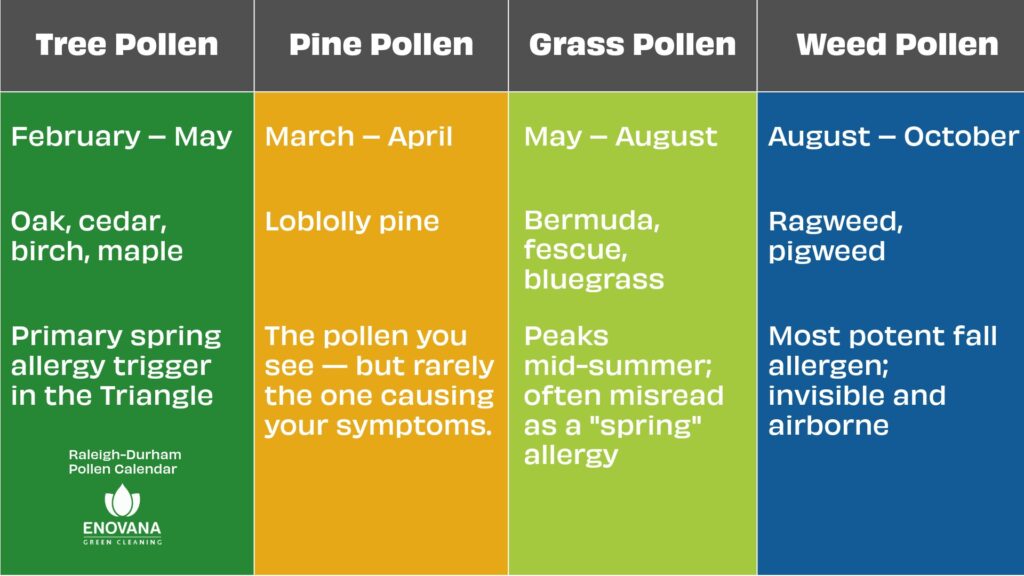
The practical takeaway: a homeowner whose symptoms peak in July isn’t responding to spring tree pollen — they’re responding to grass pollen. And someone who feels worse in September may not realize ragweed season is at its peak. The pollen calendar matters because the cleaning response should match what’s actually in the air.
How Pollen Gets Into Your Home — and Where It Settles
How Pollen Enters Your Home
Closing windows during peak pollen hours helps, but pollen has more ways in than most people realize:
- Shoes and clothing — pollen clings to fabric and transfers to floors and upholstered furniture the moment you sit down
- Pets — fur carries and holds pollen effectively; every indoor trip brings more in
- HVAC systems — if your filter isn’t changed frequently during peak season, your system recirculates captured pollen back through the house
- Window screens — screens block insects but not pollen; fine pollen grains pass through screen mesh freely
- Attached garages — opening and closing a garage door creates an air exchange that draws pollen in
Where Pollen Accumulates Inside Your Home
Once inside, pollen doesn’t distribute evenly. It settles based on airflow patterns and surface texture. The highest-concentration areas:
- Windowsills and window tracks — pollen settles here first; most homeowners wipe the sill but miss the track
- Hard floors near entry points — pollen carried in on shoes concentrates in entryways and hallways
- Upholstered furniture and carpet — fabric holds pollen at the fiber level; regular vacuuming with a HEPA-filter vacuum is the only effective removal method
- HVAC vents and returns — both supply and return vents accumulate pollen on the louvers and inside the duct opening
- Ceiling fan blades — fan use during pollen season redistributes settled pollen back into the air
- Bedding — pollen transferred from hair and skin during sleep accumulates in sheets and pillowcases faster than most people expect
Room-by-Room Pollen Cleaning Guide
This section pairs each area of the home with the specific pollen accumulation problem and the non-toxic cleaning approach that addresses it effectively.
Entryways and Mudrooms
The problem: This is where the highest concentration enters. Shoes, bags, and outerwear deposit pollen directly onto floors and any nearby surfaces.
What to do:
- Establish a shoes-off policy during peak season — place a mat and a shoe rack at the entry
- Wipe hard floors with a damp microfiber mop rather than a dry broom; dry sweeping redistributes pollen into the air
- Use a slightly damp cloth to wipe down bags and coats before hanging them
Enovana’s approach: We mop entryway hard surfaces with a diluted castile soap and water solution — effective at lifting fine particulates without leaving a chemical residue that irritates airways.
Bedrooms
The problem: Pollen transfers from hair and skin to pillowcases and sheets nightly. As WRAL reported in March 2026, going straight to bed after time outdoors means you’ve coated your bedding with pollen — and you’ll be sleeping in it all night.
What to do:
- Wash pillowcases at minimum once per week during peak season; bedding every 10–14 days
- Shower before bed during high-pollen days to remove pollen from hair before it transfers to pillows
- Vacuum mattress surfaces monthly with a HEPA-filter vacuum
- Wipe ceiling fan blades with a damp microfiber cloth before turning fans on for the season
Enovana’s approach: We dust ceiling fans, wipe windowsills and tracks, and vacuum upholstered surfaces with HEPA-equipped equipment as part of our recurring service during pollen season.
Living Areas
The problem: Upholstered furniture, area rugs, and curtains hold pollen effectively. This is often where allergy symptoms are worst because people spend the most time here.
What to do:
- Vacuum upholstered furniture weekly with a HEPA attachment
- Launder washable curtains or wipe non-washable blinds with a damp microfiber cloth
- Replace throw pillow covers more frequently than usual during peak season
- Avoid aerosol sprays — including air fresheners — which can trigger respiratory symptoms already aggravated by pollen
Enovana’s approach: We avoid all synthetic fragrance products in living areas. Our microfiber cloths trap particulates rather than redistributing them.
Kitchens
The problem: Kitchens are often treated as a lower-priority pollen zone, but pollen settles on counters and gets transferred to food prep surfaces.
What to do:
- Wipe counters with a damp cloth before food preparation during high-pollen days
- Clean the tops of cabinets and the refrigerator — elevated horizontal surfaces collect significant pollen that gets redistributed during cooking
Non-toxic options: A diluted white vinegar solution (1:1 with water) or castile soap and water are both effective for counter surfaces. Neither leaves a residue that affects food prep areas.
Bathrooms
The problem: Lower pollen accumulation, but HVAC vents in bathrooms are frequently overlooked.
What to do:
- Wipe vent covers monthly with a damp cloth during pollen season
- Avoid aerosol disinfectants during pollen season — the spray itself can aggravate respiratory symptoms
Non-Toxic Cleaning Products and Methods for Pollen Season
The instinct during allergy season is often to disinfect more aggressively. The problem: many conventional cleaning products contain aerosols, synthetic fragrances, and chemical residues that are respiratory irritants in their own right. Swapping one airway irritant for another doesn’t help.
| Cleaning Task | Avoid | Non-Toxic Alternative |
|---|---|---|
| Hard floor cleaning | Scented floor cleaners, steam mop with chemical solution | Damp microfiber mop with diluted castile soap + water |
| Surface wiping | Scented spray cleaners, aerosol disinfectants | Microfiber cloth dampened with diluted white vinegar or castile soap solution |
| Upholstered furniture | Febreze, scented fabric sprays | HEPA vacuum; baking soda left briefly then vacuumed for deodorizing |
| Window tracks | No specific alternative needed | Damp cotton swab or folded damp microfiber cloth |
| Air freshening | Aerosol sprays, plug-in air fresheners | Ventilation during low-pollen hours (early morning); baking soda in open container |
| HVAC filter | Standard fiberglass filters | MERV-11 or MERV-13 rated filter; change every 30–60 days during peak season |
A Note on HEPA Vacuums
Standard vacuums without HEPA filtration pick up pollen from surfaces and exhaust a portion of it back into the air. A HEPA-rated filter captures particles as small as 0.3 microns — well within the size range of grass and weed pollen grains (typically 10–100 microns). If you’re investing in one change this season, a HEPA-filter vacuum has a measurable impact on indoor allergen levels.
A Note on Air Purifiers
A standalone HEPA air purifier in a bedroom or main living area provides meaningful allergen reduction during peak season. The EPA recommends choosing a purifier sized appropriately for the room — look for the CADR (Clean Air Delivery Rate) rating on the packaging, which indicates how quickly the unit filters the air volume of a given room size.
What Enovana Green Cleaning Does Differently During Pollen Season
Enovana has served Triangle-area homes since 2007, and pollen season home cleaning in Raleigh is one of the most common reasons new clients reach out each spring. Our product standards don’t change with the season — but our focus areas do.
During peak pollen season, recurring service visits include additional attention to:
- Ceiling fan blades (wiped before use, not after pollen has distributed)
- Window sills (a frequently skipped area that accumulates concentrated pollen)
- Baseboards and floor transitions (pollen settles into floor-level horizontal surfaces)
- Upholstered furniture surfaces (vacuumed with HEPA equipment)
Every product we use is non-toxic and environmentally responsible — no synthetic fragrances, no aerosol sprays, no bleach or ammonia. For a household already managing allergy symptoms, that matters. Cleaning shouldn’t add chemical irritants to an already irritated airway.
Learn more about our eco-friendly approach and why Triangle families have trusted Enovana since 2007. Or read our companion post on reducing allergens for pet-owning households — pets are a significant pollen vector that often goes unaddressed.
Frequently Asked Questions About Pollen and Home Cleaning
How often should I clean during pollen season? For households with allergy sufferers, high-contact surfaces — entryways, counters, and frequently used furniture — benefit from wiping down two to three times per week during peak season. Full home cleaning every one to two weeks provides the most meaningful allergen reduction.
Does mopping make pollen worse? Dry mopping and dry sweeping redistribute pollen into the air before it can be captured. A damp microfiber mop — or a mop with a slightly wet pad — captures pollen at the surface level rather than lifting it. Always use a damp method during pollen season.
What’s the best time of day to open windows for ventilation? Pollen counts are typically lowest in the early morning (before 10 a.m.) and after rain. Mid-afternoon, particularly on warm, dry, and windy days, is when outdoor pollen concentrations peak. The NCDEQ pollen forecast and apps like Pollen.com provide real-time Triangle area counts.
Can cleaning products make allergy symptoms worse? Yes. Aerosol sprays, synthetic fragrances, and volatile chemical compounds in conventional cleaning products can irritate airways that are already sensitized by pollen exposure. Fragrance-free, non-toxic cleaning products reduce this compounding effect.
Does Enovana use HEPA vacuums? Yes. HEPA-filter vacuums are standard in Enovana’s equipment because they capture fine particulates rather than exhausting them back into the room — which matters year-round and especially during pollen season.
How does pollen season in Raleigh compare to other NC cities? Pollen season home cleaning in Raleigh, NC is a more significant undertaking than in most other state metros — Raleigh consistently ranks among the highest-pollen cities in North Carolina due to its dense tree canopy (particularly oak), warm springs, and proximity to piedmont grasslands.
A Cleaner Home Makes Allergy Season More Manageable
Pollen season in the Triangle isn’t going to get shorter — the trend line has moved consistently in the opposite direction over the past two decades. But the indoor environment is one thing you can control.
Knowing where pollen accumulates is the foundation of effective pollen season home cleaning in Raleigh and across the Triangle — how to remove it without adding chemical irritants, and which surfaces deserve more attention during peak season, is the rest.
If you’d like a team that already uses non-toxic, environmentally responsible products as standard practice — and knows which areas matter most during pollen season — Enovana Green Cleaning serves Raleigh, Durham, Cary, Apex, Holly Springs, Morrisville, and the surrounding Triangle area. Transparent pricing, flexible scheduling, no contracts.
Learn about recurring cleaning services or book a cleaning before the next pollen wave arrives.
Read Part 1 of our pollen series: Pollen Season in Raleigh: How to Protect Your Home & Health