
If you share your home with a dog, a cat, or both, the cleaning products you use matter more than most people realize. Pets spend their lives low to the ground — walking across freshly mopped floors, licking their paws, pressing their faces into furniture. What gets left behind after cleaning doesn’t stay put.
According to the ASPCA Animal Poison Control Center, household cleaning products accounted for 6.5% of all pet poison calls in 2024 — a category that includes cleaning agents along with items like deoxidizers and batteries.
This guide covers the specific ingredients most harmful to dogs and cats, what products contain them, and what pet-safe alternatives actually work — including what Enovana Green Cleaning has used in Triangle-area homes since 2007.
Why Dogs and Cats Are More Vulnerable Than You Might Think
Exposure isn’t limited to a pet knocking over a bottle. The more common routes are subtler and harder to control:
- Paw contact — pets walk on cleaned floors and then lick their paws
- Residue — surfaces that look dry may still carry chemical traces
- Direct skin contact — cats in particular absorb compounds through grooming
- Inhalation — fumes from sprays and disinfectants linger at floor level, where pets breathe
Cats have an additional vulnerability: they lack a key liver enzyme (glucuronyl transferase) that helps metabolize many chemical compounds. Ingredients that a dog’s body can process slowly may be acutely toxic to a cat. The ASPCA specifically flags phenols, certain essential oils, and cationic detergents as especially dangerous to cats for this reason.
Dogs, by contrast, tend to be more likely to ingest products directly — chewing containers, licking spills, or drinking from a recently cleaned toilet bowl. Their exposure risk is behavioral as much as chemical.
8 Cleaning Ingredients Toxic to Dogs and Cats
The table below draws from guidance published by the ASPCA Animal Poison Control Center and clinical data from PetMD.
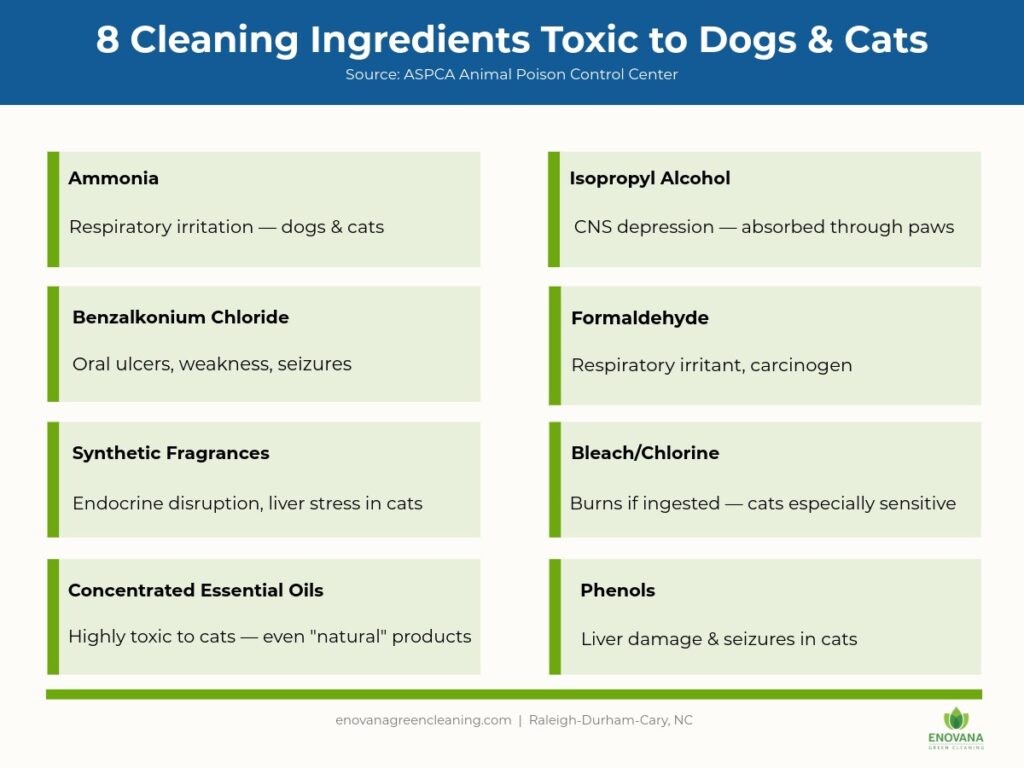
| Ingredient | Found In | Risk to Dogs | Risk to Cats |
|---|---|---|---|
| Ammonia | Glass cleaners, multi-surface sprays (e.g. Windex) | Respiratory irritation; can cause chemical burns at high exposure | Respiratory irritation, toxic if concentrated |
| Chlorine / Bleach (Sodium Hypochlorite) | Disinfectants, bathroom cleaners, Comet | GI upset, esophageal burns if ingested undiluted | Especially sensitive; fumes can cause distress |
| Phenols | Pine-based cleaners, Lysol, antiseptic sprays | GI irritation, paw burns | Highly toxic; liver damage, seizures possible |
| Benzalkonium Chloride (Cationic Detergent) | Sanitizing wipes, fabric softeners, germicides | Burns to mouth/esophagus, weakness, seizures | More sensitive; severe oral/esophageal ulcers |
| Isopropyl Alcohol | Disinfectant sprays, rubbing alcohol | CNS depression, vomiting, coordination loss | Same; absorbed through skin or paws |
| Formaldehyde | Some disinfectants (listed as formalin, methanal) | Respiratory irritation, carcinogen | Respiratory irritation, carcinogen |
| Synthetic Fragrances / Phthalates | Scented sprays, air fresheners, fabric softeners | Possible endocrine‑disrupting effects with repeated, long‑term exposure | Cats lack certain liver enzymes needed to process some fragrance chemicals efficiently |
| Essential Oils (concentrated) | DIY cleaners, diffusers, some “natural” products | GI upset, CNS issues at high concentration | Highly toxic; liver damage, aspiration pneumonia |
Note on essential oils: Even products marketed as “natural” or “green” can be harmful if they contain concentrated essential oils. Tea tree, eucalyptus, clove, thyme, and oregano oils are particularly dangerous for cats. The ASPCA recommends against using essential oils in any area where cats have access unless approved by your veterinarian.
How to Read a Cleaning Product Label for Pet Safety
Ingredient labels on cleaning products can be intentionally difficult to read. The same harmful chemical often appears under multiple names. Here are the label names to watch for:
- Bleach — sodium hypochlorite
- Phenols — phenolic acid, carbolic acid, butylated hydroxytoluene, alkylphenols, pine oil
- Formaldehyde — formalin, formic aldehyde, methanal, methylene, quaternium-15
- Cationic detergents — benzalkonium chloride, cetrimonium bromide
- Isopropyl alcohol — rubbing alcohol (listed with a % concentration)
If a product clearly lists bleach (sodium hypochlorite) or cationic detergents like benzalkonium chloride, avoid using it in pet areas. When in doubt, check the full ingredient list or review the ASPCA’s guidance on household cleaning products and pets at the ASPCA Animal Poison Control Center.
What to Look For Instead
- EPA Safer Choice label — every ingredient reviewed by EPA scientists that are safer for people, pets, and the environment
- EWG “A” rating — the Environmental Working Group’s independent safety assessment Fragrance-free designation — eliminates phthalate and synthetic fragrance exposure
- Plant-derived surfactants — castile soap and coconut-based surfactants are well-tolerated
- Biodegradable formula — breaks down into harmless compounds after use
In August 2024, the EPA strengthened its Safer Choice Standard to specifically expand criteria for pet care products — requiring that certified products use only the safest possible ingredients for both humans and pets.
Pet-Safe Cleaning Alternatives — Room by Room
You don’t need to compromise on cleanliness to keep your pets safe. These pet safe cleaning products and alternatives are effective for everyday household cleaning tasks:
| Cleaning Task | Avoid (Why) | Pet-Safe Alternative |
|---|---|---|
| All-purpose cleaning | Lysol, Fantastik (ammonia/phenols) | Plant-based castile soap + water |
| Bathroom scrubbing | Comet, Ajax (chlorine bleach) | Baking soda + water paste |
| Floor cleaning | Pine-Sol (phenols toxic to cats) | Diluted white vinegar or EPA Safer Choice floor cleaner |
| Glass / windows | Windex (ammonia) | Diluted white vinegar + microfiber cloth |
| Deodorizing | Febreze, scented sprays (synthetic fragrance) | Baking soda left open, ventilation |
| Disinfecting | Bleach sprays undiluted | Properly diluted hydrogen peroxide (3%); ventilate and allow to dry before pet access |
A Note on Vinegar
Diluted white vinegar is widely recommended as a pet-safe cleaner, but undiluted vinegar can cause GI irritation in pets who ingest it and mild irritation to paws. Always dilute (typically 1:1 with water) and allow surfaces to dry before allowing pets back in the area. The ASPCA notes that diluted vinegar solutions used as directed are not expected to cause significant problems.
A Note on Baking Soda
Baking soda is one of the safest and most versatile cleaning agents for pet households. It’s non-toxic, effective for scrubbing sinks, tubs, and countertops, and doubles as a deodorizer for pet areas. At Enovana, we switched from Bon Ami to baking soda as our primary abrasive cleaner — better for pets, better for the environment, and more economical at scale. See our full comparison of Baking Soda, Bon Ami, and Comet to understand why we made the switch.
What Enovana Green Cleaning Uses in Your Home
- Castile Soap
- Vinegar
- Baking Soda
Every product Enovana brings into a Triangle‑area home is chosen to be as safe as possible for people and pets, relying on plant‑based cleaners like castile soap along with low‑toxicity staples such as baking soda and vinegar.
That’s not a marketing claim — it’s a standard we’ve held since we started in 2007.
Here’s what that means in practice:
- No bleach, ammonia, or phenol-based products
- No synthetic fragrances or artificial dyes
- No residue from bleach, ammonia, phenols, or synthetic fragrances left on floors, counters, or pet areas
- Baking soda as our primary abrasive cleaner — safe for food surfaces and pet zones
- Cotton rags instead of disposable wipes — more effective and no chemical-soaked fibers
The result is a home that’s genuinely clean — without the invisible layer of chemical residue that many conventional cleaning services leave behind on the surfaces your pets touch every day.
Learn more about our eco-friendly approach and why Triangle families have trusted Enovana since 2007.
If You Suspect Your Pet Was Exposed to a Toxic Cleaner
Act immediately. Do not wait for symptoms to worsen.
- Contact your veterinarian immediately
- ASPCA Animal Poison Control Center: (888) 426-4435 — available 24/7
- Pet Poison Helpline: (855) 764-7661
- Have the product label or container available when you call
- Do not induce vomiting unless specifically instructed to by a veterinarian
A Cleaner Home Starts with Safer Products
The floors your dog walks on, the counters your cat jumps onto, the air your pets breathe while you clean — all of it is affected by what’s in your cleaning products. Switching to plant-based, non-toxic pet safe cleaning products doesn’t require sacrificing cleanliness. It just requires knowing what to look for — and what to leave on the shelf.
If you’d rather leave the cleaning to a team that already uses pet-safe products as standard practice, Enovana Green Cleaning serves Raleigh, Durham, Cary, Apex, Holly Springs, Morrisville, and the surrounding Triangle area. No contracts, flexible scheduling, and the same non-toxic standard in every home we clean.
Learn about our recurring cleaning services or book your first pet-safe cleaning today.